
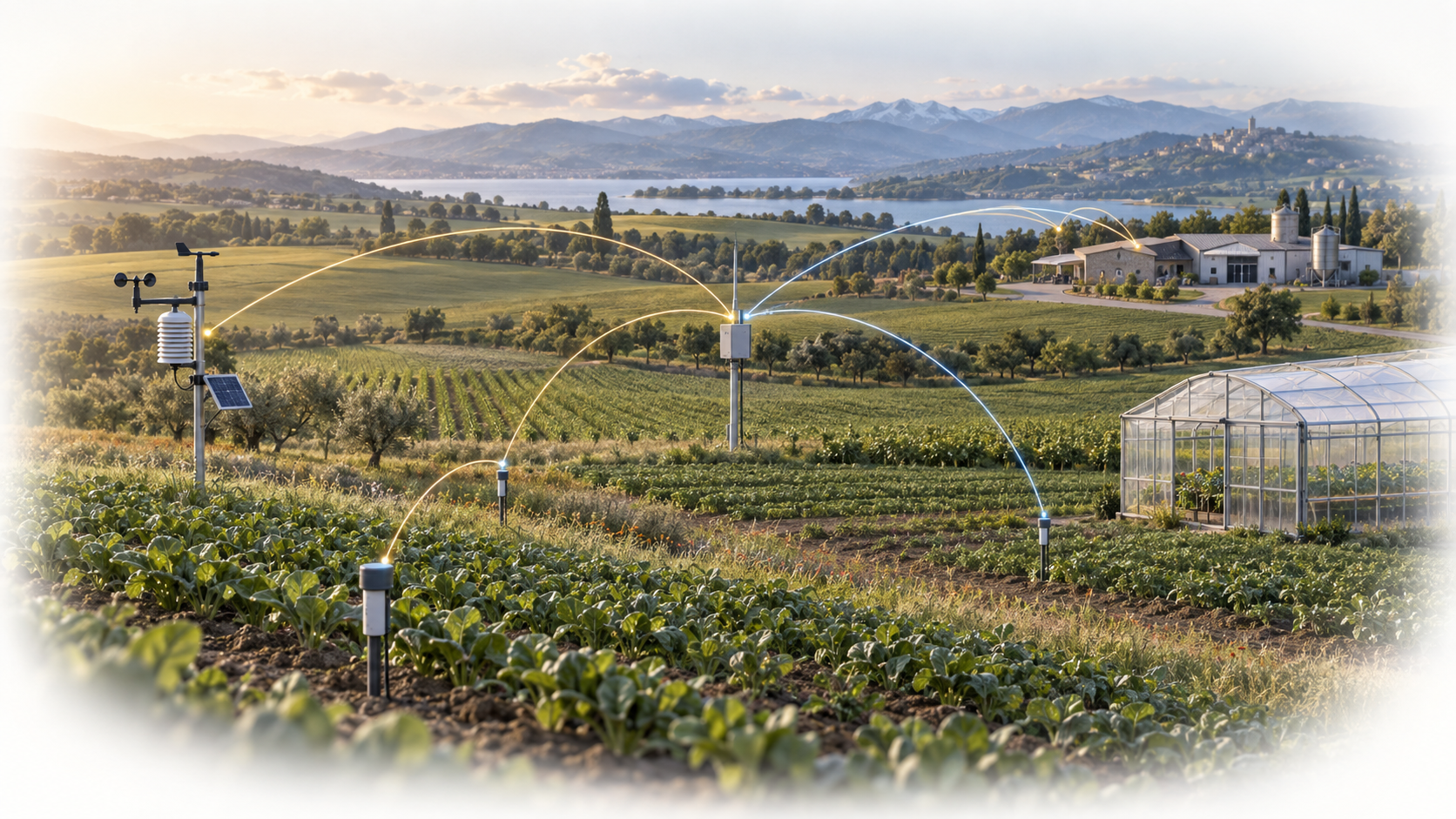
What does industrial IoT mean here?
Conditions are not identical across every part of a field
Soil conditions, weather, irrigation demand and greenhouse environments change across space and time. Industrial IoT collects data from dispersed measurement points and brings it into farm decision processes, so action need not rely on an impression from just one location.
Industry context
72%was agriculture’s share of global freshwater withdrawals in 2023.
What does this mean for digitalisation?
The value of field data related to water is not merely technical: measurements linked to place and time can support the preparation and later assessment of irrigation decisions.
Source:Food and Agriculture Organization of the United Nations: SDG 6.4.2 — Level of water stress (2023)
A global withdrawal share; local water balance and irrigation decisions require site-specific data.
The digital opportunity
Not one technology, but a connected operational picture
Value emerges when field data is connected to the industry’s actual decision contexts.
Soil and microclimate
Soil moisture, temperature and weather data can be interpreted with their measurement location and time.
Irrigation and resource planning
Trends can help time inspections and action, without replacing the agronomic model or decision.
Greenhouses and remote infrastructure
Separate production sites, mechanical assets and environmental values can be organised into a shared operational view.
Large areas, low power
Radio coverage, power supply, maintainability and device life together determine whether the system works in practice.
Where can it improve visibility?
From field signal to useful context
Location-specific data
Soil moisture and other environmental values stay connected to their measurement point.
Fewer blind spots
Changes at more distant sites can be followed where coverage allows.
Better-timed attention
Trends help decide which site to inspect and when.
The data path
From measurement point to operational decision
Field sensor
Soil, weather or greenhouse measurements.
LoRaWAN and backhaul
Local radio data collection and transfer to the receiving system.
Farm overview
Measurements interpreted with their location, time and operating process.
Where does Intelliport fit?
In the layer between the field point and usable data
Intelliport focuses on connectivity, device management and system integration adapted to the actual environment. We do not replace the industry process, professional judgement or receiving applications.
Field gateway and backhaul
Matching LoRaWAN collection and mobile backhaul to the site conditions.
Remote management and edge
Supervising communications devices and, where justified, processing data locally.
Partner ecosystem
Supporting integration of customer or partner sensors, the LNS and agricultural application.
Related solution
Explore the detailed solution
The detailed solution explains the roles of dispersed sensors, radio collection and central access.
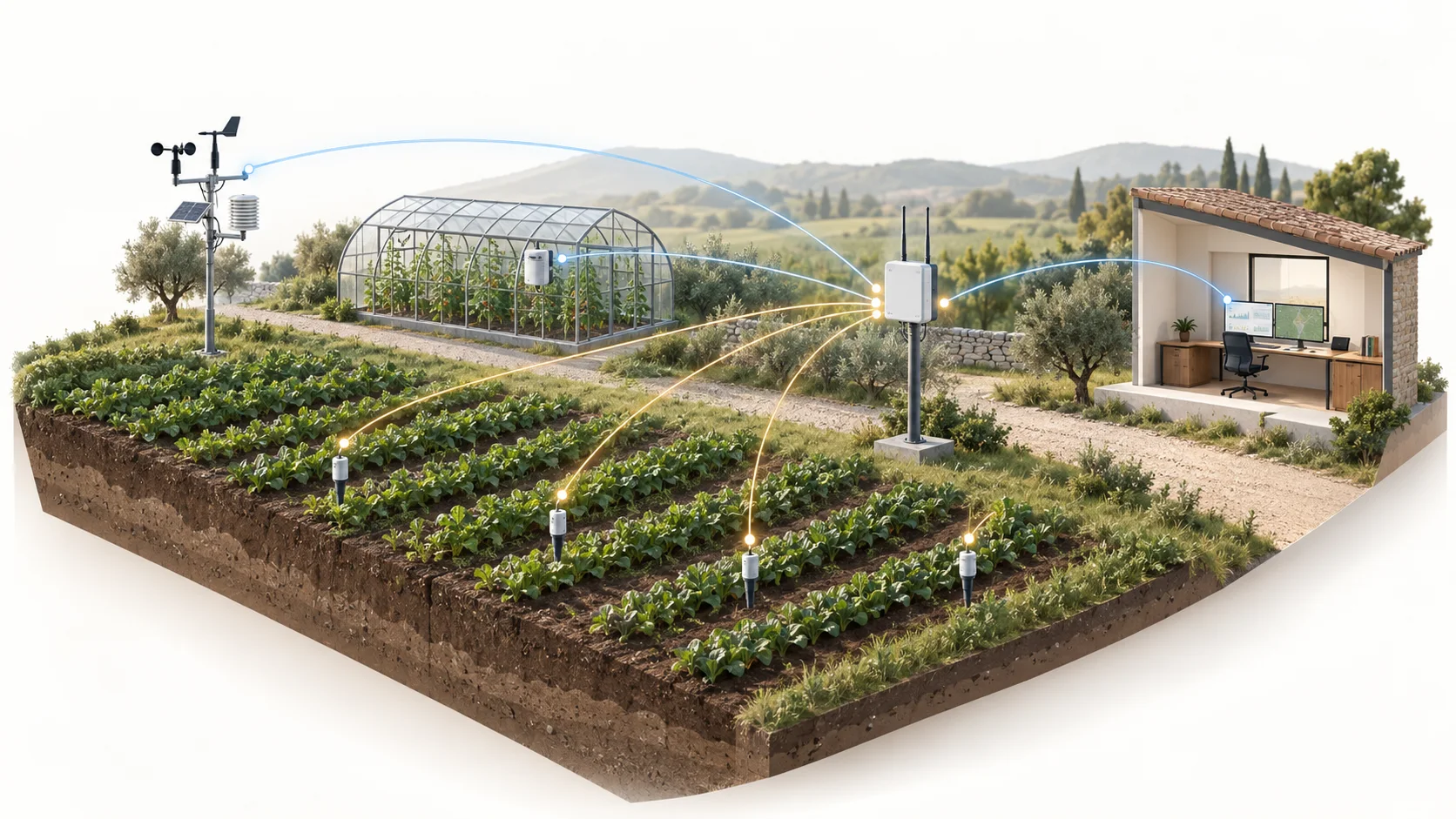 Industrial IoT · SolutionLoRaWAN data collection in agricultureCollecting data from dispersed field points for decisions in farm operations.Explore solution
 Designed for your environment
We start with your actual operating environment
Coverage, sensors, frequency use, power supply and backhaul must be designed for the site and the actual devices.